
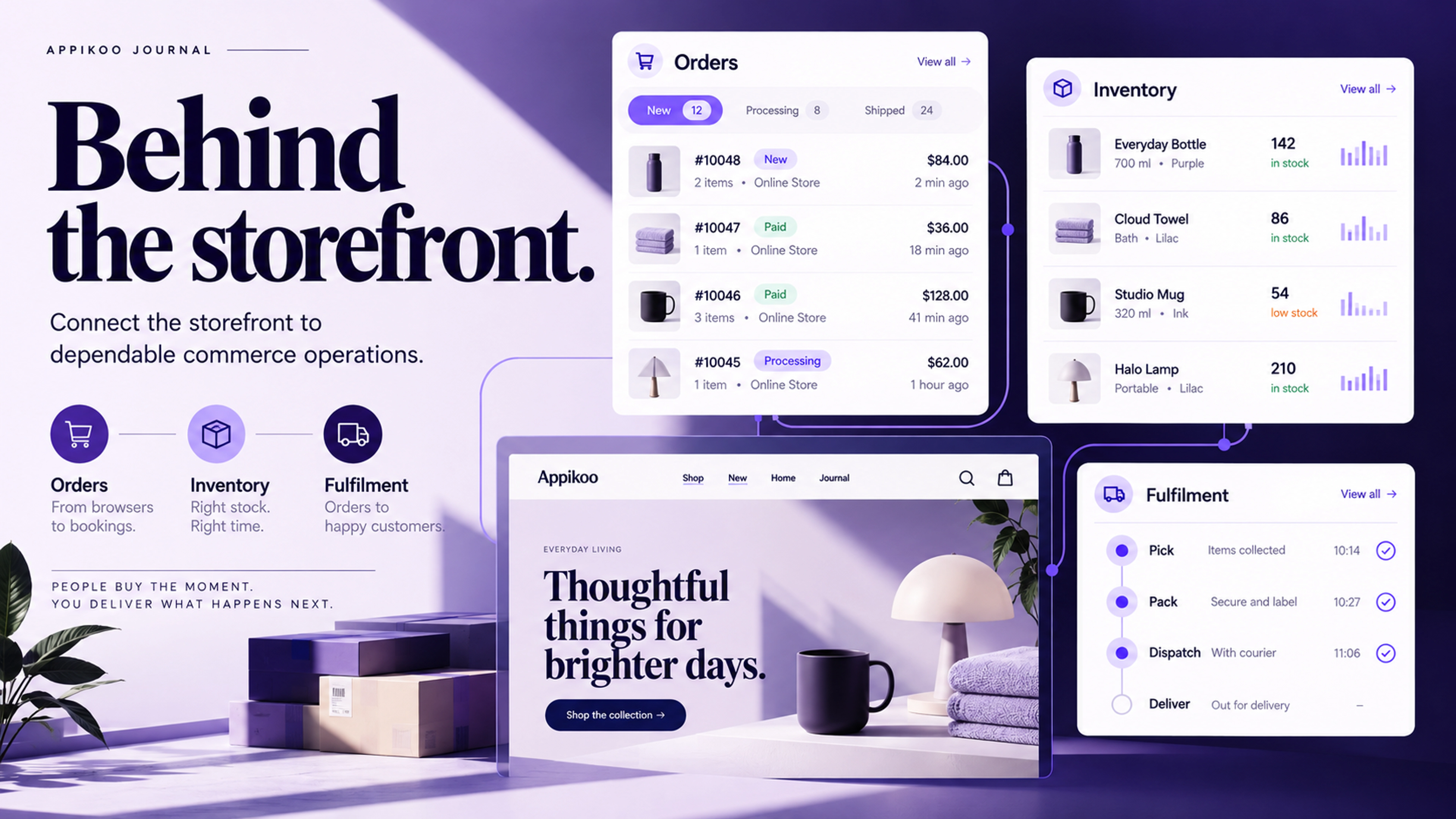
The visible storefront is only part of an online shop. Product information, stock, payments and fulfillment need explicit ownership and recovery rules to keep customer promises aligned with operational reality.
01.Choose a source of truth for each domain
Decide which system owns product descriptions, prices, inventory and order status. These responsibilities may be distributed across several tools, but each field needs an authoritative origin. Otherwise a manual correction in one place can be overwritten by the next synchronization.
Document update direction and expected delay. A catalog description can often tolerate a different update rhythm from stock availability. Make that distinction explicit in the customer experience instead of displaying every value as if it were equally fresh.
02.Model the order as a sequence of states
An order may be created, awaiting payment, confirmed, prepared, shipped or cancelled. Define the permitted transitions and the event responsible for each one. Avoid scattering these rules across unrelated screens and background jobs where they become difficult to review.
Use an imagined overselling scenario to expose gaps: two customers attempt to buy the final item at nearly the same time. Specify how availability is checked, how reservations expire and who resolves a discrepancy. The answer must be operational, not only visual.
03.Design integrations for interruption
External services can be slow or temporarily unavailable. Keep a record of work that needs to be retried and identify repeated events so that they do not create duplicate actions. A successful API response is not a substitute for checking the resulting business record.
Provide a practical reconciliation view for operators. They should be able to find a payment without an associated order, a shipment without an update or an item awaiting attention. This reduces dependence on developers for routine operational investigation.
04.Test the handovers that customers never see
Before launch, trace representative orders from the product page through fulfillment and cancellation. Assign ownership to exceptions and document recovery. A dependable shop is one where the team knows how to repair a broken handover without losing the history of what occurred.